Suspension
Front Suspension
Zero's motorcycles all feature telescoping fork front suspension.
Front Suspension Specs
| Fork | Shock | ||||||||||
|---|---|---|---|---|---|---|---|---|---|---|---|
| Years | Manufacturer | Description | Material | Model | Part# | Travel | Measurements | Oil | Material | Part# | Measurements |
| 2009-2010 | FastAce | DS/X | BDA53AR (discontinued) | ||||||||
| 2012-2013 | 〃 | 38mm (from Zero website/manual) inverted forks with adjustable compression and rebound damping | 6061-T6 Forged Aluminum (per this thread) Chrome-Moly inner tube; Alloy steel spring wire |
S | ALX07RC (discontinued) 22-05418-03 Right 22-04464-05 Left 22-04463-05 |
140mm | Compression 12 clicks; Rebound 21 clicks | 6061-T6 Forged Aluminum (per this thread) | BDA58RC (discontinued) | ||
| 〃 | 〃 | 〃 | 〃 | DS | Left 22-06093-02? Right 22-06094-02? (APX05RC? or APX10AR? (discontinued)) |
7.00 in (178 mm) | clarification? Distance 900 mm Travel 220 mm |
〃 | BFA57RC (discontinued)) | Rebound Adjustment 12 clicks |
|
| 〃 | 〃 | 〃 | 〃 | FX/MX/XU | XU - ALX07RC AP18A0179-B002 22-02749-01 | XU 51mm (manual) 130mm (website) MX 82mm (manual) 240mm (website) FX 240mm |
〃 | ||||
| 2014 | 〃 | 43 mm inverted forks with adjustable compression and rebound damping | 6061-T6 Forged Aluminum (per this thread) Chrome-Moly inner tube; Alloy steel spring wire |
S/SR | 6.25 in (159 mm) | 6061-T6 Forged Aluminum (per this thread) | BDA58RC (discontinued) | ||||
| 〃 | 〃 | 〃 | 〃 | DS | APX16RC - 22-06867-05 Right 22-06869-05 Left 22-06868-05 |
7.00 in (178 mm) | Compression 11 clicks; Rebound 20 clicks | 〃 | BFA57RC (discontinued)) | Rebound Adjustment 12 clicks |
|
| 〃 | 〃 | 〃 | 〃 | FX | 230mm | 〃 | |||||
| 2015-2020 | Showa | 41 mm inverted cartridge forks, with adjustable spring preload, compression and rebound damping | Outer Tube Finish Natural Anodized (silver) Slide Tube Finish Nickel - Hard Chrome Rebound (Tension) Finish Black Anodized Compression Finish Black Anodized |
S/SR | 6.25 in (159 mm) | Free length 461.5mm. Outer diameter 36.2mm. Stock spring rate 7.4 N/mm |
Type SS-8 Level 117 mm |
Body Finish Natural Anodized (silver) Rod Finish Nickel - Hard Chrome Rebound (Tension) Finish Black Anodized Compression Finish Black Anodized |
|||
| 〃 | 〃 | 〃 | 〃 | DS/DSR | 7.00 in (178 mm) | 〃 | |||||
| 〃 | 〃 | 〃 | 〃 | FX | Left 22-05868-02 Right 22-05869-02 |
Free Length 789.1±2.0mm Max Length 798mm Min Length 580mm Stroke 218mm Spring Rate 5.4 N/mm Rebound (Tension) Max - 9 clicks Compression Max - 5 clicks Preload Min + 3.0 turns |
Type SS-8 Volume 442±2.5cm3 Level 103mm |
〃 | 22-05879-02 | Spring Rate 73.6-82.4 N/mm Free Length 320±2.0mm Max Length 320.5mm Min Length 246mm Stroke 74.5 Rebound (Tension) Max - 12 clicks Compression Max - 9 clicks Preload 2nd Position |
|
| 〃 | 〃 | 〃 | 〃 | FXS | 〃 |
Fork Oil Change and Spring Replacement
Fork Oil Level Note
Measure from outer tube end to oil surface (Condition: spring, spring joint, spring collar, seat rubber, slider, fork bolt are removed and dust seal touches axle holder)
Reference
FastAce fork oil change / spring replacement+ part 2 by Ray Ivers
Tools
- 7mm Allen wrench for riser bolts.
Steps
- Put the motorcycle on a stand.
- Remove the risers and handlebars using a 7mm Allen wrench.
- Loosen the fork caps, front axle, and brake caliper bolts while the front wheel is on the ground.
- Fork cap / spring removal...
- Oil change...
- Fork spring / cap replacement...
Notes
| What | Torque | Bolt |
|---|---|---|
| Handlebar clamps | 15 ft/lb | M8 |
| Handlebar risers | 25 ft/lb | M10 |
| Triple clamps (all) | 15 ft/lb | M8 |
| Fork caps | 15 ft/lb | M46 |
| F caliper bolts | 18 ft/lb | M8 |
| F axle end cap | 15 ft/lb | M8 |
| F Axle clamps | 9 ft/lb | M6 |
Fork Cartridge Revalving
Fast Ace fork revalving by Ray Ivers
The procedure is described in great detail for FastAce (2013-2014) suspension but could be adapted for the newer Showa suspension.
Verify Fork Spring Rate
Reference
How to Verify Fork Spring Rate
Tools
- A tip-tie long enough to wrap around the fork tube.
Steps
- Add a zip-tie to the the fork tube.
- Make sure it is snug so it stays in the place it was last pushed too.
- Once the zip-tie is on the fork tube, you push it up to rest it against the upper fork.
- Measure bike sag (unloaded)
Lift the front fork off the ground and measure the gap (zip-tie to fork gap) created by the front weight of the bike. 3. Measure rider sag (loaded) 1. Now push zip-tie back up the fork, then sit on the bike and raise your feet so all of your weight is carried through the suspension. 2. Then carefully dismount and put kickstand down. 3. Measure the gap (zip-tie to fork) created by your weight. 4. Add this gap measurement to the bike sag measurement, this is the total sag.
This measurement should be around 25% of the working range of the front suspension.
Now that is a guideline; it can be higher or lower than 25%.
It depends on what is happening when you are loading up the suspension (upper end). 4. Checking the upper end by using the zip-tie.
After riding, check the location of the zip-tie: the gap from the fork to the zip-tie.
Lets say the measurement is 5". Then you would know the total max travel used was 5" + bike sag measurement.
That total measurement should never equal the total suspension travel amount (6", I think based on your posting).
- If it equal, then you are bottoming out. Increase the preload and see if this keeps you from bottoming out.
- If you use max preload and are still bottoming out, you will need stronger springs.
- If you find you are only using 75% to 80% of the max suspension travel, you can reduce the preload spacer length some or you can live with this.
- If you are only using ~50% or less of the suspension travel, your springs are probably too stiff. You should swap springs to a lower rate spring.
Rear Shock
Zero motorcycle models use a single shock absorber rear suspension, joining the Swingarm to the Frame.
Rear Shock Mounting
The rear shock fastens to the Swingarm's right side arched arm.
The upper mount reaches the frame ahead of the tail area.
Rear Shock Specifications
| Years | Brand | Model | Description | Media | Specs | Models | Travel | Length |
|---|---|---|---|---|---|---|---|---|
| 2013-2014 | FastAce | BDA58RC | Piggy-back reservoir shock with adjustable spring preload, compression and rebound damping | 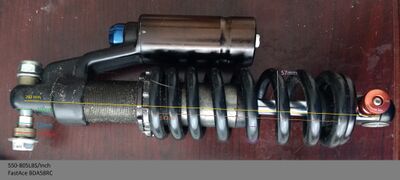 2013 S Rear Shock FastAce BDA58RC |
Spring Rate 550 ~ 805 lbs/in Spring Length 142mm, Diameter 57mm Bottom bushing width 11/16" Top bushing width ~1.25" |
S/SR | 6.35 in (161 mm) | 10.25-10.5 in (260mm) |
| 〃 | 〃 | 〃 | 〃 | 〃 | 〃 | DS | 7.03 in (179 mm) | |
| 〃 | 〃 | BFA57RC Part 22-06105-03 |
〃 | - 319mm / 12.56" eye-eye - 17.9mm / .705" eye width (top & bottom) - 31.95mm / 1.258" bushing width (top & bottom) Resevoir offset angle ('clocking angle'): 242° CW / 118° CCW from 12 o'clock offset width (shock centerline to far LH side of reservoir): @ 90mm / 3.60" Spring Rate 475-585 lbs/in. Spring 181mm / 7.125" length (on shock, no load, min. preload) |
FX | |||
| 2015-2020 | Showa | 40 mm piston, piggy-back reservoir shock with adjustable spring preload, compression and rebound damping | S/SR | 6.35 in (161 mm) | ||||
| 〃 | 〃 | 〃 | 〃 | 〃 | 〃 | DS/DSR | 7.03 in (179 mm) |
Rear Shock Adjustment
Notes
The Official Manual section on Rear Shock Adjustment illustrates how to measure preload and check sag.
Compression
The official manual's description here is adequate and this can be done readily by hand on the right side of the bike at the top of the shock.
Rebound
The adjustment knob is at the bottom of the shock facing rear, as described in the manual, and can be worked by hand or with a wrench with a careful reach into that area.
Spring Preload
The official manual illustrates the collar and procedure for spring preload adjustment, but does not recommend a specific tool, and there are clearance issues in that area for tools.
The adjuster sleeve diameter is 58mm (2.3").
A Stockton spanner wrench was found to be suitable for the job if modified as follows (per 2017 DSR Showa rear shock spanner wrench):
- Grind the nose of the wrench to fit the notches.
- Bend the wrench a couple of degrees to clear the Sevcon motor controller fins.
Obviously, a better solution is still worth seeking.
A small suspension wrench / ER collet spanner size 30/32 can be use even with the lack of clearance
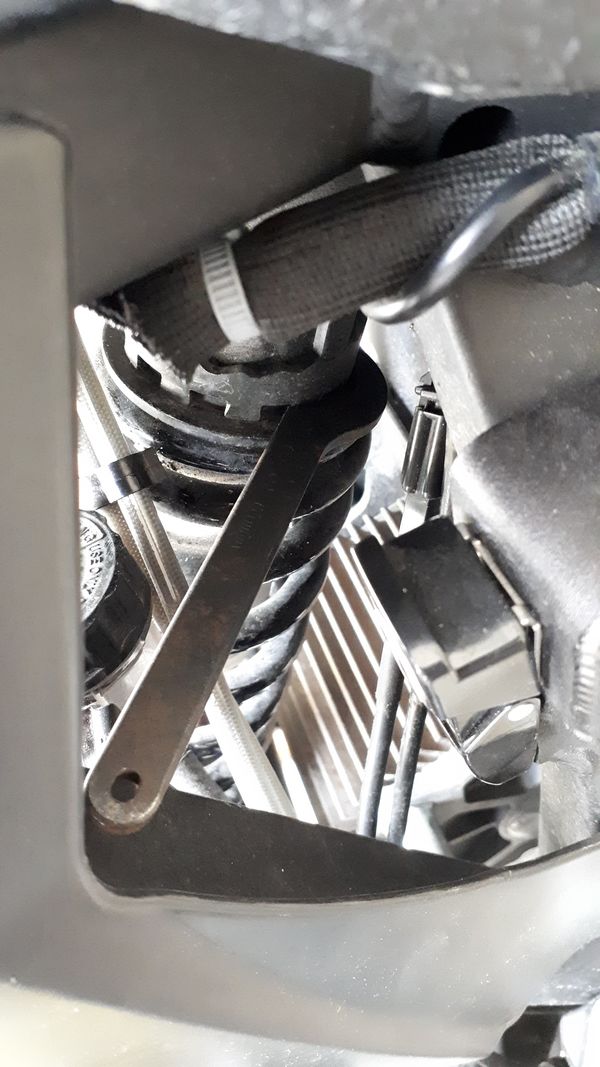 Suspension wrench around the collar
Source: zeromanual.com/wiki/FST_Platform/Unofficial_Service_Manual · Wayback capture of 2025-05-17 · wiki last edited 2 May 2020 00:04. Community-written content from the Unofficial Zero Manual, reproduced for preservation; not written or verified by OpenZero. Links to pages that were not mirrored go to the Wayback Machine.