Battery
The following guidance includes advice adapted from MostlyBonkers' research summary and Battery Notes from a Farasis Engineer.
Battery Concepts
Basic Concepts
Metaphorically speaking, think of a river and a reservoir.
Volts
water pressure.
Amps
volume of water flowing.
Charge (Kwh)
how much water is behind the dam.
Power (kW)
the rate at which water is flowing.
Charge Tips
Generally, refer to the Charger Operation section, but for battery concerns, the following are relevant:
- If you run your bike to empty, do your best to give it at least a partial charge (ideally to 40-50%) as soon as you can.
- Charge and discharge your bike freely and at your convenience.
- Don't worry about keeping the bike topped up, like standard car batteries.
- Don't feel you have to run the bike to empty before re-charging; it's fine to charge if you've only used 10%, for example.
- If you can afford extra chargers to reduce charging time, Zero's fast chargers won't hurt the batteries.
- Use the bike as much as you can. If you aren't using it for a regular commute or aren't lucky enough to have the freedom to ride regularly then it will work out a lot cheaper to own a conventional motorbike.
- Zero's engineers have done the work to ensure a long service life from their battery packs and have backed it up with a five year warranty with the 2014 model range onwards. That should be enough to drop any anxiety you may have and just concentrate on enjoying the bike.
Battery Capacity
Battery capacity is a measure of the charge a battery can deliver at an intended voltage.
Cells themselves are usually rated for a current amount delivered over an interval of time (going from maximum voltage to a rated minimum).
Batteries as banks of cells aggregate that measure across the cells.
Because of a number of factors including internal resistance, a higher discharge rate effectively lowers the usable capacity of the battery during that cycle.
This variance in the usable capacity of the battery has meaning for how an electric motorcycle performs with different riding styles.
Normally, the energy a battery can store is estimated by taking nominal voltage (V) times the current capacity of the battery's cells (Ah) = the energy delivery capacity (Wh) (divide by 1000 for kWh).
PackVoltagenominal (V) × CellCapacity (Ah) = EnergyCapacity (Wh)
However, based on industry convention, Zero calculates battery energy (the kWh) by taking the maximum voltage the battery has at 100% capacity times the capacity in Ah, instead of nominal voltage.
Maximum Voltage
Maximum voltage is only present at the beginning of discharge when it is full, and then it drops (nonlinearly).
Nominal Voltage
The nominal voltage is like the average voltage the battery over the entire discharge range.
The average is the voltage measured at the battery terminal when it has 50% charge state and is disconnected from any load.
For example, the 2013 S has 100Ah and a nominal 102V: the total energy the battery has is:
102V × 100Ah = 10200Wh = 10.2kWh
But if you use maximum battery voltage you get:
116V × 100Ah = 11600Wh = 11.6kWh
This also applies when adding a power tank, confusing customers about the official rating versus what the mobile application reports.
Regardless of this complexity of measurement, Zero's range figures appear reliable in the general context of the test conditions.
Cells
The current manufacturer of cells for Zero's power packs is Farasis who are supplying pouch cells for the 2013+ model range (Gen2 and Gen3).
NMC Cell Chemistry
The chemistry used is Lithium Nickel Manganese Cobalt: LiNiMnCoO2 ("NMC" or other rearrangements of those letters).
NMC is a relatively new battery chemistry which differs from the Li-cobalt chemistry we are familiar with from mobile phone batteries and laptops.
While Li-cobalt has a higher energy density than NMC (storage capacity per kilogram), it doesn't cycle as well and ages quicker.
That's fine for a mobile phone that is likely to be obsolete after 2-3 years, but not for an electric bike.
The automotive-grade NMC cells that Farasis supply should easily satisfy the requirements of the five year warranty that Zero are providing with their current Z-Force battery packs.
It seems they should last 8-10 years if they aren't abused.
Even if you start to notice some significant deterioration after five years, the rate at which battery technology is progressing means that you should be able to buy a new battery pack with much better capacity (range) than the original for less money.
| Voltage | |||||||||
|---|---|---|---|---|---|---|---|---|---|
| Years | Form | Manufacturer | Model | Datasheet | Capacity | Minimum | Nominal | Maximum | Dimensions |
| 2009-2011 | cylindrical | Molicel | IMR-26700A | Molicel 26700 [13] [14] | 2.9Ah | 2.5V | 3.8V | 4.2V±50mV | 26.4mm ⌀ × 70mm |
| 2012 | pouch | EIG | EIG C020 | EIG NCM C020 | 20Ah | 2.5V | 3.65V | 4.15V | 130mm × 217mm × 7.2mm |
| 2013-2014 | 〃 | Farasis | Farasis 25Ah | Farasis IMP06160230P25A 25Ah or alt | 25Ah | 2.0V | 3.65V | 4.15-4.20V | 161mm × 230mm × 6mm |
| 2015 | 〃 | 〃 | Farasis 27Ah | 〃 | 27Ah (25Ah label) | 〃 | 〃 | 〃 | 161mm × 230mm × 6mm |
| 2016-2017 | 〃 | 〃 | Farasis 29Ah | 〃 | 29Ah (28Ah label) | 〃 | 〃 | 〃 | 160mm × 230mm × 6mm |
| 2018 | 〃 | 〃 | Farasis 32Ah | 〃 | 32Ah (? label) | 〃 | 〃 | 〃 | 160mm × 230mm × 6mm |
Farasis Claims
Per Farasis engineers and industry professionals:
25Ah
A solid cell, and are Farasis's oldest chemistry design.
They are a manganese-rich cathode (NMC) 25Ah cell with excellent cycle life, and acceptable C-rate.
27Ah
An adaptation of the 25Ah cell chemistry with thinner foils and more of them.
This means that there is more active materiel (more capacity) but less conductive path to get that capacity in and out.
So for the slow discharge S/DS bikes, you get more capacity, but they are lower C rate, and cannot handle being used in the FX platform.
29Ah
Higher discharge rate (peak and continuous) than the 25Ah cell.
More capacity than the 27Ah cell (especially at higher C rates/cooler temperatures).
32Ah
10% capacity improvement and very likely lower internal resistance.
Internal weight savings and better cooling are inferred.
| Discharge | Charge | |||
|---|---|---|---|---|
| Cell | Continuous | Peak (10sec) | Max Burst | Maximum |
| 25Ah | 4C (100A) | 7C (175A) | 400A | 1C (25A) |
References
2014 ZERO BATTERY CHEMISTRY (Z-FORCE® POWER TANK SECRET SAUCE)
DoctorBass on Endless Sphere: Zero Motorcycles BATTERY for your E-projects!!
Charged EVs: New (32Ah) Farasis lithium-ion pouch cell balances power and energy density
Battery notes from a Farasis Engineer. @ ElectricMotorcyleForum
Cell Arrangement
Cell arrangement (also battery arrangement or battery configuration) refers to how the cells are grouped to provide power with sufficient current and voltage output for the application.
- Series arrangements raise pack voltage
- Parallel arrangements increase pack current capacity, as well as balance cells if they are cross-connected.
Notation
See Battery Cell Arrangement Notation to understand how Zero's battery cell arrangements are described.
| Cell | Voltage | Series | Pack Voltage | Years | Platform | Configuration | |
|---|---|---|---|---|---|---|---|
| Molicel 26700 | 3.8V | 14 7⨉2s banks |
48V (min) 53V (nominal) ≈ 3.8V × 14 58V (listed/max) |
2009 | S | 14s24p | Monolith (12 or 24 parallel) |
| 〃 | 〃 | 〃 | 〃 | 2010-2011 | X | 14s12p | 〃 |
| 〃 | 〃 | 〃 | 〃 | 〃 | S | 14s24p | 〃 |
| EIG C020 20Ah | 3.65V | 18 | 65.7V (nominal) ≈ 3.65V × 18 74.7V (max) |
2012 | X | 18s1p | 1 module |
| 〃 | 〃 | 〃 | 〃 | 〃 | S | 18s2p or 18s3p | 2 or 3-brick monolith |
| Farasis 25Ah | 〃 | 28 | 116V (max) 102V (nominal) ≈ 3.65V × 28 84V (min) |
2013-2014 | XMX | 28s1p | 1-2 removable modules |
| 〃 | 〃 | 〃 | 〃 | 〃 | SDS | 28s3p or 28s4p | 3 or 4-brick monolith |
| 〃 | 〃 | 〃 | 〃 | 2015 | XMX | 28s1p | 1-2 removable modules |
| Farasis 27Ah | 〃 | 〃 | 〃 | 〃 | SDS | 28s3p or 28s4p | 3 or 4-brick monolith |
| Farasis 29Ah | 〃 | 〃 | 〃 | 2016 | XMX | 28s1p | 1-2 removable modules |
| 〃 | 〃 | 〃 | 〃 | 〃 | SDS | 28s3p or 28s4p | 3 or 4-brick monolith |
| 〃 | 〃 | 〃 | 〃 | 2017-present | XMX | 28s2p | Long Brick (fixed), or 1-2 removable modules |
| 〃 | 〃 | 〃 | 〃 | 〃 | SDS | 28s2p or 28s4p | Long Brick with storage, or 2xLong Brick monolith |
References
2011 Zero S battery rebuild to Tesla cells reveals Molicel construction for the 2009-2011 era.
Zero Motorcycles BATTERY for your E-projects!! by DoctorBass
Brick
Zero arranges Farasis cells in 28-cell series in modular form, referred to as "bricks" because they're bathed in an epoxy after assembly. The brick configuration is "28s1p".
Both the Power Tank and Power Pack Module products encapsulate a single brick.
For the S platform 2014+ years, installing the Power Tank changes a "4p" to a "5p" (and presumably "3p" to "4p" but this seems unlikely).
Components and Weight
28 cell ⨉ 485 g/cell = 29.9 lb
For 2015, each brick weighs 32 lb, implying 2.1 lbs for epoxy/etc.
Dimensions
8? x 7.5 x 9.75in (HxWxL)
References
DoctorBass' repackaging of a 25Ah brick into two, length-wise reveals some structure.
Long Brick
The 2017 model year shifted Zero's battery assembly to a "half monolith" or "long brick" configuration containing the same number of cells as for 2 bricks.
A single BMS manages the cells in both stacks.
Model Changes
- The 2017 S and DS models offer a 2p arrangement using a single long brick arranged along the forward half of the monolith frame area.
This configuration leaves the rear half of that area empty for a storage bin accessed from the side of the frame.
The prior 3p configuration is no longer for sale, but can be created by adding a Power Tank.
The long brick for this model does not have the same gapped casing that a Monolith has
So, it is less insulated from cold but dissipates heat better. - The 2017 XMX Platform models are delivered by default with a non-removable long brick (aside from the MMX Model).
They are available optionally with single removable bricks like prior model years for an additional cost of about $500.
Design
The long brick arrangement figures suggest that each brick aligns its cells with the other brick.
- Layout appears to be more efficient as a result.
- Interconnects between the bricks seem to be trivial and nearly-zero-resistance, improving cell life.
- There is unsupported speculation that 56s1p arrangement is a possible future evolutionary step as a result.
Dimensions
15" tall × 9 3/4" wide × 6 1/2" deep.
There will be some plastics on it with the contactor and bms inside that add about 2" to the height and 1" to the depth for about half of the height of the battery.
Facebook comment for measurements
Long brick Monoliths
For 2017 packs, made with "long bricks", the interconnects are extremely simple, only connecting two stacks which are aligned directly against each other.
2017 monoliths consist of two "long bricks" with simpler interconnects.
Battery Management System
Zero's Battery Management System (BMS) consists of a proprietary board within the battery case to manage the cells.
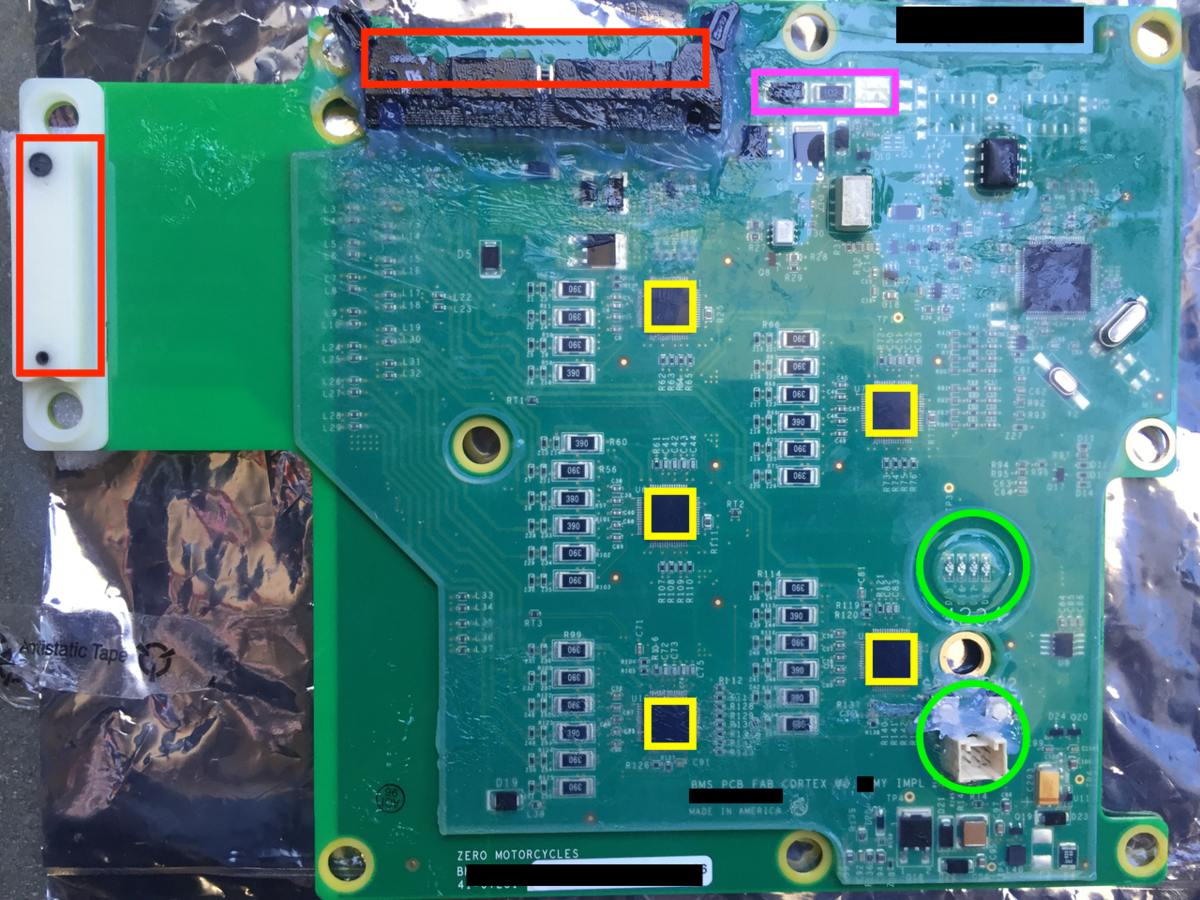 2016 BMS with potting
The same board model seems to be capable and used for both single-brick (XMX Platform) bikes and power pack (SDS Platform) bikes, given software configuration changes. The board appears to be OEM-designed and has revision numbers that indicate progression over time from the 2013 model line.
Power Note
This is the one power drain on the vehicle when it is completely turned off with no charging, but it draws a very minor amount of power like a "sleep" mode.
 Warning: |
The board is entirely solid state and not designed for fixing, only replacement. Any damage to this board will disable the motorcycle. |
| Warning: |
The board has full battery voltage inputs to it at all times. Take extreme care to avoid connections that could short, arc, or ground. Before accessing the BMS, first turn the bike off and disconnect charging. This ensures that the contactor is open and you do not interact with the BMS while it performs a cel balancing operation. |
Location (SDS Platform / Monolith)
Behind the lower front face of the battery behind the front forks/wheel.
Remove the lower front body plastics and the front battery face to access the unit.
Location (XMX Platform / Power Tank)
Each separate brick has its own BMS inside the armored casing.
The long brick has one BMS module inside the armored casing.
Revisions
The BMS has changed layout over the years to match the monolith (particularly for long brick architecture) and increased in physical robustness and protections.
TODO identify those revisions and describe them.
Protections
The board is mounted with rubber vibration dampening.
The board is layered with a very thick coating ("dam and fill potting") to protect the components from moisture and shock damage.
The rubber pads covering reset buttons and LED indicator lights (for 2015+ models) have dielectric grease coating (CP70 datasheet) those components.
- The covers are not there to make it waterproof, only to keep the dirt out of the grease.
- MY13 bikes had no grease. MY14 bikes had a different grease that did not age well, and CP70 is worth applying to both MY13 and MY14.
- Maintain that coating and do not pressure wash the front of the battery casing to avoid damaging this board.
Inspecting
If the BMS stops working (no indication from the lights, no response to reset), the appropriate, non-warrantee-risking thing to do is take it to a dealer and they'll likely replace it under warrantee.
But if a dealer visit is difficult or there's an emergency, a visual inspection might inform what's going on (naturally, a bike that doesn't work feels like an emergency; use your judgement).
Basically, uncover the BMS and look for burned out components.
There is a large pin connector which may be loose, which would explain a loss of power to the BMS. Apparently this is very difficult to work with but can be re-attached carefully.
Don't loosen the BMS mounting without a very good reason - it's always connected to battery cell voltage by some pins on the side that run into the batter pack so a spark there might be damaging.
If you are going to lift off the BMS, take extreme care with the fasteners and dampeners to not drop them into the battery casing.
You'll also need to restore each and every fastener and dampener because the BMS mount prevents vibration damage.
Diagnostics
The mobile app can extract BMS logs, but it is a very slow and error-prone process compared to MBB log extraction.
The front of the board has a diagnostic port for a live debugging connection.
A cable to access the serial connection of the diagnostic port is described here
BMS Architecture
Some general speculation here about how the BMS is designed and arranged, correlated with BMS board examination.
2016 BMS with potting
Stackable Cell Monitor With Overvoltage Protector and Balancing
The product identifier "PL536" occurs in BMS logs, referring to a TI BMS chip that handles 3-6 cells in series.
The Zero BMS has 5 of these (visible on the front of the board above).
The 5 chips divide up the 28 cell series into groups that each chip monitors (seemingly 6 per chip until the last chip handles 4 for a total of 28).
References
BMS Reset
For a number of errors, the official manual recommends resetting the BMS.
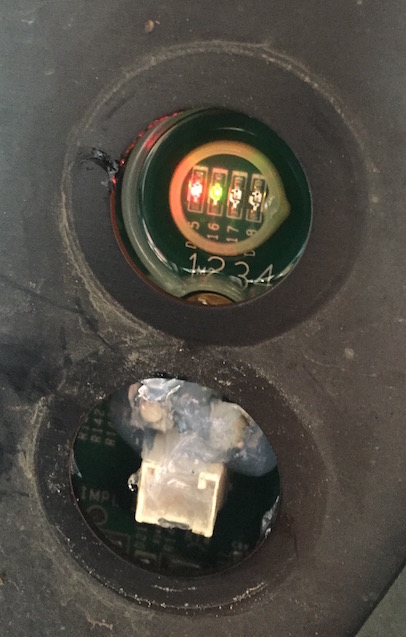 BMS indicator lights and reset windows on a 2016 DSR
Steps
- Key the bike off and unplug it from charging.
Wait for the contactor to click open. 2. Uncover the battery LED indicators.
2015-2016: Remove the upper rubber pad from the front of the battery case.
2013-2014,2017+: Remove the rubber pad from the front of the battery case.
The uncovered hole reveals a string of small LEDs: one red on the left followed by four green.
They'll indicate charge level when the bike is keyed off. 3. Uncover the diagnostic connection port and reset buttons.
2015-2016: Remove lower rubber pad from the front of the battery case.
2013-2014,2017+: These were uncovered in the previous step.
Notice a white plastic port coated in dielectric grease.
Above that port are two small micro-switch buttons which are the reset buttons. - The left (as you face it) button performs a hardware reset. - The right (as you face it) button performs a software reset. 4. Press to reset
2013-2014: There is only one reset button above the plastic port which performs a hardware reset.
2015+: Take a pen (say) and depress the (right) software reset button for a few seconds and then release.
Expect the BMS indicating LEDs to go dark while the button is depressed and then turn on again when release.
The lights should stabilize after an initial startup sequence for a few seconds. 5. Check whether the error code is clear by keying on the vehicle or whatever is appropriate. 6. 2015+: If the error is still present after a software reset, try the hardware reset button in the same way. 7. 2015+: If the error is still present after a hardware reset, try both at the same time. 8. Replace the removed pads.
Cell Balancing
Cell Balancing is a self-maintenance process by the BMS.
It ensures that cells operate at very well-matched states of charge to ensure even load and better battery performance and overall lifetime.
Mechanism
The BMS has connections to the battery cells via the interconnect wiring and can sense cell voltage.
There are 28 contacts on the side of the back of the board (as viewed from the front of the bike looking at the battery) which connect to each cell in the "brick" series.
The BMS feeds small amounts of current to cells that are abnormally low in order to maintain battery longevity and minimize the possibility of cell damage.
It detects voltage levels on all cells, through interconnects between bricks that harness each cell in the same position in the brick's series, and through this same path able to balance cells by targeting current to the cells with the lowest voltages.
Cell balancing because of the limitations of this circuit can take a long time and is part of why Zero recommends keeping the motorcycle plugged in when unattended by default.
Stations that shut off when current draw is low (such as ChargePoint) may not allow balancing to complete.
Cell balance may be monitored with the Zero app, however only a single number is presented, the value (in millivolts) of the worst imbalance.
Schedule
Cell balancing often happens at low current levels, mainly during charge tapering when the charger is operating at the voltage limit in "constant voltage" mode.
It also can happen when the bike is long-term plugged in but turned off. The BMS may wake up and control charging specifically to balance the cells.
Precharge
Precharge is a BMS pre-ride startup function to charge the main power bus before closing the contactor.
The BMS has a precharge circuit for ensuring that the contactors can close without causing damaging current spikes to the controller or other components.
Precharge is necessary because of capacitors in the controller; connecting sets of capacitors electrically requires care to match voltages because of the rate at which capacitors will charge and discharge to each other to balance potentials.
See Precharge Theory for a detailed explanation.
Operation
- When the motorcycle is keyed on, precharge supplies a low amount of power (fused at 10A) to the controller-side main bus.
- Voltage should climb above 85V within 4-5 seconds of powering on.
- At this point, the BMS measures the voltage on both sides and decides to close the contactors.
- If this process fails, precharge will stop and then the voltage level will decay.
You will likely see error code 25 for a precharge error on the dash (when error codes are selected for display).
| Warning: |
The precharge circuit is not isolated from the controller or accessory charging port, and can be damaged if a large transient current is induced from an outside source to a de-energized motorcycle. |
Precharge Failure
A recent (mid-2016) firmware update improves the robustness of the precharge logic especially when used with accessory charging systems that are permanently connected to the vehicle.
If while starting the bike, the sequence completes before the contactor closes, the green run light for the motorcycle will flash until the contactor does close.
To address a failed precharge on startup:
- Key the bike off if after several seconds, the contactor has not shut with an audible click and the green run light is still flashing.
- Wait 2 seconds (ensuring the dash indicator goes fully dark) and then key the bike on again.
This should allow precharge to get a boost from residual charge from the last precharge startup cycle. 3. Repeat a few times if necessary. If the contactor never shuts, check the logs and any error codes.
State of Charge
State of Charge is a calculation meant to help estimate remaining energy in the Battery.
Concepts
SoC is a porportional representation; a percentage (fraction), so it is only applicable with a known total or max.
Riders all have experienced different ranges under different temperatures, various environmental conditions etc.
So full is really a subjective term, like asking When is a balloon full? Before it pops? But if you fill it with cold air then move to a warm environment, it pops.
- Paraphrase of ElectricZen's explanation
SoC is most easily calibrated using the battery pack's voltage at rest or near rest.
This is a rough guide to correlating at rest battery voltage to the state of charge.
There is respectable unofficial guidance that this curve varies as the pack ages over its lifetime.
These figures are determined from some selection of owners with logs, with minimal experimental controls.
| Warning: |
Your mileage may literally vary! |
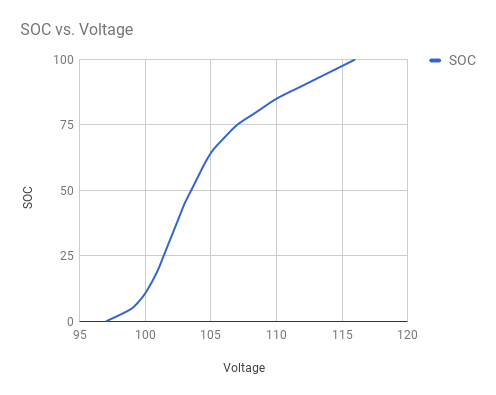 % SoC vs Voltage
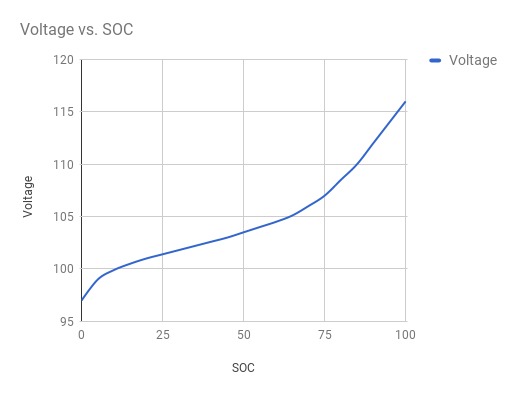 Voltage vs % SoC
| VPack | VCell | SoC |
|---|---|---|
| 115.9…116.2 | 4.14…4.15 | 100 |
| 113.9…114.24 | 4.07…4.08 | 95 |
| 112.0…112.3 | 4.00…4.01 | 90 |
| 109.76…110.8 | 3.92…3.96 | 85 |
| 108.36 | 3.87 | 80 |
| 106.96 | 3.82 | 75 |
| 105.56 | 3.77 | 70 |
| 104.16 | 3.72 | 65 |
| 103.04 | 3.68 | 60 |
| 101.92 | 3.64 | 55 |
| 101.36 | 3.62 | 50 |
| 100.80 | 3.60 | 45 |
| 99.68 | 3.56 | 40 |
| 99.12 | 3.54 | 35 |
| 98.56 | 3.52 | 30 |
| 98.00 | 3.5 | 25 |
| 97.16 | 3.47 | 20 |
| 96.60 | 3.45 | 15 |
| 96.04 | 3.43 | 10 |
| 95.76 | 3.42 | 5 |
| 95.20 | 3.4 | 0 |
(Obsolete) SoC Indications per protomech
Before Zero removed pack capacity readout from the mobile app, there were some corroborating indications available:
- The app appeared to simply show kWh using Zero's max capacity rating, i.e. present voltage times present amp hours.
- The voltage and amp-hours were likely to be correct, but the kWh readout was a rough guide at best.
- The percentage reading adjusted to the estimated pack maximum over time, so as the pack aged, the reported Ah and kWh readout would decrease, but not the maximum percentage.
Variance across Battery Pack Years
- The sensor equipment measuring current and temperature for the battery pack improve over the years, impacting SoC indication.
2017 model year bikes appear to have an increased range of current sensor calibration quality, improving that year's estimations. - Cell behavior also varies over the years, generally improving in robustness.
One can find multiple complaints of going into limp-home mode at 5-15% from 2014 SR owners, for example.
Variance by riding conditions
- Cell discharge is an electrochemical process that depends on the cells' physical conditions.
- The resistance of the cell (which should be low) increases with environmental factors like temperature.
This results in reduced performance, since the resistance lowers the terminal voltage of the cells and the overall battery pack. - At low SoC values, SoC might drop considerably once the BMS observes low terminal voltage as an indirect result of low temperatures or a cell imbalance.
The lowest-performing cell becomes the limiting factor in pack performance at low voltage / SoC, and Zero does not provide indications to help you anticipate or diagnose this.
Other References
BMS SoC Estimation
BMS State of Charge (SoC) Estimation
SoC is inherently an abstract / simulated measure, not one that can be directly proven with enough physical inputs.
The actual proof of state of charge is to fully discharge the battery, running an integral of current as discharged (this is the Current Method of Estimation).
But a "full" discharge must be decided from a measurement, too, taking minimum cell voltage, which sometimes (and possibly for certain cell generations) can have a single cell fall in voltage early causing SoC to drop early.
And this voltage can be a dynamic result of the rate of discharge, so that restarting the bike after a few minutes' rest period can show a higher SoC than before.
BMS estimation modes
- Current Integration Method, or "coulomb counting", which measures the battery current over time and estimates its integral or sum.
Battery current will reverse for regen mode and for charging, and this is measured and included in the estimation. 2. Voltage Method, a fairly inaccurate but simpler method where battery voltage is measured and then dynamically compensating the voltage reading by a correction term proportional to the battery current, and by using a look-up table of battery's open circuit voltage vs. temperature.
Voltage correlates to SoC well at the empty and full states, but less well in the plateau area of 20-80%.
Method Switching
The SoC method may switch during operation, and should be indicated in the event logs.
It appears to change primarily when charging starts or stops; it is probably triggered by the battery's Charge Mode state.
When the method switches, SoC may change dramatically (by 12% or more) with no clear explanation.
Temperature Effects
Batteries are chemical systems that can be very complicated to summarize.
One of the main capacity factors is the pack temperature, which is determined by both outside temperature and any heat produced internally from resistance during charging and discharging.
Temperature appears to be a significant factor in building the SoC estimation for either method.
Examples
Walk through the logic of SoC boundary parameters with some stock Zero equipment.
Equipment
Farasis 25Ah cells (using the datasheet available) in a 28 cell series.
Static Voltage Walkthrough
The 116V reported by the mobile application at 100% SoC corresponds to 4.14V (=116V/28).
0% state of charge at least naively then would correspond to 92.4V ( = 3.3V × 28).
The nominal cell voltage listed (3.65V) then corresponds to a nominal pack voltage of 102.2V, which does reflect the relatively stable battery voltage reading near the middle of the state of charge cycle in steady state.
Reframing (per Terry)
Zero will let you discharge to about 88 volts and up to 116.4 volts.
By the Farasis data sheet, this is using the full capacity of the cells with the exception of about 4 volts from the whole pack.
84 volts would be 3.0V per cell but 88 volts is pretty close.
88 volts is about 3.14V per cell and there is less than 1% energy left at 3.14V.
In any case, the state of charge calculation is driven by attempting to bracket vehicle usage to stay in this range.
The desired voltage range (to maintain battery chemistry over the stated lifetime) drives stated limits, coupled with an estimation of the amp-hours remaining from any given point in the collective state of the battery pack.
SoC Calibration
SoC Drift
The SoC has an inherent drift based on inherent sources of error:
- An integral is not generally computable from time-sampled measurements.
- Battery current sensors seem to have calibration targeted at the high end of the range (highway speeds) and do not have a known recalibration program; likely a non-linear output.
- Temperature measurements must rely on sensors in specific positions in the battery (with no feasible ideal position).
Steady throttle usage should experience less drift than wildly varying usage, but the inherent measurement problems still lead to some drift.
SoC Drift Correction
SoC drift is only really eliminated by the battery reaching an equilibrium state.
The BMS seems to recalibrate SoC for the 100% condition:
- Pack voltage at 116.2V.
- Battery state at rest via either:
-
0A charge or discharge current.
with some few minutes time spent with the charger disconnected. 2. ~0.8kW charge rate
NOTE: observed by testing with a controllable switching supply; onboard charging can substitute.
Battery Storage and Capacity with Age
Chemically, the cells mainly age in two ways:
- The electrolyte reacting with the active components of the cathode and anode in the cells, and releasing gas (calendar life).
- The interaction between the lithium ions and the anode/cathode blend that causes a small amount of damage each time they are cycled. (Cycle life)
You just have to come to terms with the fact that from the moment the battery pack is manufactured it will very slowly lose overall capacity regardless of whether you use it or not. Li-ion batteries are good at holding their charge so you don't need to worry about letting them stand for a long time, providing they've got a reasonably good state of charge (SoC). At 40-50% SoC the overall capacity loss due to aging is minimized. At full charge the aging effects are increased but not by such a great amount that it should cause any great concern. For some owners it might be wiser to follow Zero's recommendations and just leave the bike plugged in for however long you plan to store the bike. This at least makes sure the individual cells stay balanced with each other and there's little risk of them dropping to a very low SoC at which point the aging effects begin to increase. If you let the SoC drop below their minimum threshold you run the risk of the battery pack becoming unusable. I think that's why Zero recommend leaving the bike plugged in over winter. If there's some sort of power cut mid-winter and the bike isn't checked for a few months, then at least there's a good chance the battery won't have discharged too much.
Farasis recommendations:
The manufacturer might state that you will get 500 cycles from a battery and they will be referring to full cycles. However, if you only ever use 10% of the capacity from a full charge and then top it up, you will get more cycles from it before the battery health drops to 80%. In this example you are likely to get 1500 cycles from a battery that you only ever discharge to half it's capacity. That's assuming that all other variables remain the same. In day-to-day use, variations in state of charge and temperature are more likely to affect battery life than how you cycle the battery. Taking Zero's claim's of an estimated battery pack life of 496,000 km using city ranges it would take at least 2,250 full cycles to achieve this (2014 Zero S 11.4 kWh). Taking into account the loss of capacity in this period and the figure is bound to be more like 2,500 cycles. Most trips and daily commutes will probably drop the battery to 40-50% SoC thus increasing the number of cycles we would get from the battery. Let's say we average 60 miles between charges of a 100 mile combined range over the life of the bike. Then let's allow ourselves 3,000 cycles before the battery drops to 80% health. That's still 180,000 miles. Even if we then halve that to allow for temperature and aging (very unlikely even in harsh conditions) we get a very, very conservative estimate of 90,000 miles. That should give even a heavy commuter a good five or six years of use before noticing significant reduction in range. Even then, a daily average of 60 miles would still give you a 20 mile reserve.
If you do decide to leave it at 40-50% SoC you also need to be organized enough to check the bike every couple of weeks or so. It wouldn't hurt to charge it up after a few months, leave it plugged in for a few days to make sure the cells get properly balanced, then take it for a ride to bring the SoC down to the 40-50% level again before leaving it for the next few weeks or months.
I have no doubt that the good people at Zero have done their sums, know the specifications of the batteries in detail and are confident that their battery packs will have at least 80% health after five years even if the bike is never ridden and left plugged in all the time. Zero also state in their specifications that their battery packs are good for hundreds of thousands of miles before they reach 80% of their original stated capacity. That in itself should be enough to put your mind at rest, but if it isn't then perhaps these golden rules should help:
- Don't leave the bike standing empty for more than a few days.
- If you have to store the bike for a long time, then either leave it plugged in and don't worry about it, or leave it at 40-50% SoC but keep an eye on it.
- Just use your bike as much as you can and don't worry about the battery. The engineers have thought all this through and are backing it up with a five year warranty. The whole scene will be different in five years time, so it isn't worth thinking about.
Battery Temperature Effects
Performance
Battery internal resistance is higher at lower temperatures, which means that while riding, losses to battery internal resistance mean a loss of range at lower temperatures.
Farasis quotes internal cell resistance as <2mΩ but it's not exactly clear how this translates into calculating those losses without some description of how that trends over temperature and charge rate.
The warmer the battery is, the lower these losses will be.
Below freezing temperatures, the battery chemistry will not allow effective charging at all, and Zero provides protections to prevent this until the battery's temperature has been raised sufficiently.
It follows that to get maximum performance, charging and discharging repeatedly at a high rate will raise cell temperature enough to reduce internal resistance so more will be delivered to the motor.
Degradation at high temperatures
Temperature is a bigger factor than state of charge when it comes to aging. Apparently, for every increase of 10F degrees in battery temperature across its lifetime, battery deterioration over that lifetime can double.
Heat Production
It is worth noting though that Li-ion batteries shouldn't generate a lot of heat when charging at normal rates.
On a Zero, charging at or below 4kW will not produce much heat.
Therefore, even if you live in a hot climate and have just been on a ride, the cells should cool down overall even while they are charging (although direct sunlight on the battery will add more heat).
You might want to be a little more careful if fast charging in a hot climate but don't forget that the BMS will either reduce the charge rate or stop charging altogether if the cell temperature exceeds the limits that the engineers have set. They have set these limits on the conservative side to avoid any claims on that five year warranty.
Storage
If you are going to store the bike, it makes sense to store it somewhere cool.
Fridge temperature is probably best but never store below freezing.
If you don't have the option of storing it somewhere cool, then don't worry about it.
Battery Memory Effects
There are no memory effects with Li-ion chemistry.
Some 'Smart' battery management systems might recommend performing a deep discharge followed by a full charge from time to time.
This helps re-calibrate the system and give better estimations of capacity remaining.
However, there is no need to do this from purely a cell maintenance point of view.
All Li-ion batteries have protection circuits (Zero uses the BMS and Contactor) to keep the cells within their safe operating voltage range.
You can therefore simply charge and discharge at will and not worry about charging a battery that is half full.
Rate of Charging and Discharging
The Farasis cells have a nominal capacity of 25 Ah (as of 2013-2014).
Each cell has a maximum continuous discharge rate of 100 A (4C rate).
You would have to discharge the battery in 15 minutes to achieve that, which is impossible to achieve normally.
Conveniently, the Zero S 11.4 should achieve a range of approximately 70 miles at a constant speed of 70 mph.
That would result in a full discharge in an hour.
Even maintaining 80 mph, the maximum sustained speed of the bike, it's difficult to empty the battery pack in less than half an hour.
So the cells are operating well within their specifications.
The maximum charge rate for Zero battery packs is 25A for each cell or brick (2013-2014), which would mean a full charge in an hour, referred to as a 1C rate.
Even with a 6.6kW level 2 charge, you're only going to get a full charge in 2 hours, probably more like 2.5 hrs as the charge rate will drop as the battery reaches capacity.
Yet again, the cells are under relatively little stress even with a fast charge.
Protections
Contactor
The main contactor is a high-capacity relay-operated switch separating the battery's positive side from the bike's propulsion systems.
It mutually protects the battery and the bike's systems from damaging each other, particularly for rush currents or overcurrent conditions.
Model
Contactors for the 2013+ years are GIGAVAC GX-series contactors.
The 2013 year contactor is not identified, and some reported an occasional failure mode where "contactor welded shut" could occur.
2014+ years feature the GX11, which appears to fail safe open by design (SPST-NO) and has had no significant reported issues.
Location
The 2013+ power pack contactor is housed within the "dog house", an enclosed area extending from the main power pack enclosure top face at the rear.
For the Power Tank accessory and bricks and long bricks, each enclosure has one contactor operated by the BMS within.
Behavior
See Charging Control Unit and Contactor Limits.
Theory (ref)
A contactor is a large relay: it allows a fairly small voltage/current signal to switch a much larger voltage/current.
It has two sides:
- The drive/coil side (control).
- The load (contact) side.
On the drive/coil side, there's a "kickback" diode which handles the inductive spike caused when the drive to the coil ceases.
Without that diode, the energy represented in the magnetic field inside of the coil would have no place to go, so it would cause a voltage spike which can be damaging to components.
The kickback diode gives that energy somewhere to go, allowing it to ramp down fairly slowly without a big voltage spike.
Depending on how the coil side of the contactor is wound, it has a certain current requirement to pull the contactor shut, say 12V @ 100mA, which will be provided by the driving circuitry.
There's not necessarily any relationship between the coil rating and contact rating, except that bigger (higher-current rated) contacts might be heavier and require higher coil current to get the armature to move.
The kickback diode only needs to carry this amount of current, regardless of the contact side current.
If a 3A kickback diode is specified for that contactor, it will be adequate for any contact side current.
The make/break current is the rating for the contact side of the contactor.
You won't actually want to make or break the contactor under the limiting conditions (you'll always want to both make and break the contactor at exactly 0 amps), but in an emergency, it's rated to do so without the contacts welding together -- and an emergency is what the contactor is there for.
In automotive use, you often see the coil set up for 12V, drawing maybe 100mA (the current can vary widely though).
That small current pulls the contacts together, which switches on the high-current side.
Contactor Limits
Zero's effective contactor limit for the charging rate is 95% of 1C rate.
The BMS will open the contactor for the following conditions:
Inactivity
If the motorcycle is keyed off and not otherwise set in charging mode, the contactors will open after a few seconds.
If the motorcycle is keyed on and not otherwise set in charging mode, and then 30 minutes pass without control input.
Twisting the throttle is sufficient to reset this timer; otherwise restart charging once it happens.
Voltage
Voltage is too low or too high outside its safe operating range.
If voltage is too high (117V):
- Confirm with the Zero mobile application
- Attempt to bring it back to normal range by discharging the battery:
- operating the motor (fastest but requires a closed contactor, and the Sevcon won't operate above 118V) or:
- turning on all available electrical loads.
If voltage is too low, charge by any means necessary:
Prefer the onboard charger or an equivalent rate source through the charging port.
In an emergency, the regen feature can be used to charge the battery through the motor.
Drive the motor by spinning the rear axle with a suitable power source, with the bike in Custom Mode with regen set to 100%.
Power
Incoming power exceeds 1C rate continuously for a minute. A 1C rate charges the battery fully in 1 hour.
For a battery with 13 kWh max capacity, this value will be 11.4 kWh nominal / 102V = 110A (say).
If the charge rate is too high for the battery, downgrade the charge rate manually and restart.
Field testing indicates that the short time setting for the contactor opening is 30 seconds, and that a 20 second period under that limit will reset it.
This may vary due to environmental conditions like ambient temperature.
If the battery temperature (not ambient) is outside safe operating bounds:
| Cold Battery | Normal | Hot Battery | ||||
|---|---|---|---|---|---|---|
| Range | operation prevented | charging prevented | charging tapered | operation prevented | damage likely | |
| (F) | … -22F | -22F … 32F | 32F … 110F | 110F … 122F | 122F … 140F | 140F … |
| (C) | … -30C | -30C … 0C | 0C … 43C | 43C … 50C | 50C … 60C | 60C … |
The Zero battery will emit heat while its charging rate exceeds 4 kW, and it will cool if under that threshold.
If temperature is out of safe range, do whatever is appropriate to bring the temperature back in range.
Calculating Contactor Limit Per Bike
Per Zero's specs pages:
Maximum capacity (kWh) = COUNT(cells) × (cell capacity rating (Ah)) × MAX(cell rating (V))
Example
A 2015 SR w/ Power Tank has 15.3kWh max, 13.5 kWh nominal, with a 102V nominal voltage, so is nominally rated at 133 Ah.
1C rate means that it can charge at up to 133A.
At 10% actual SOC (3.4 volts per cell), 1C = 3.4 volts per cell × 28 cells in series × 133 A = 12.7 kW.
At 95% SOC (4.1 volts per cell), 1C = 4.1 volts per cell × 28 cells in series × 133 A = 15.3 kW.
These are DC power ratings; AC input power will read 10 to 20% higher (due to conversion losses).
Contactor Limit Per Power Tank or module
The current capacity will be proportional to the number of bricks vs 4 providing a scaling factor.
Or, more directly, the Ah rating on the label indicates the 1C rate.
| Capacity (kWh) | Voltage | Capacity | Contactor Limit | |||||
|---|---|---|---|---|---|---|---|---|
| Year | Cell | # Bricks | Max | Nominal | Max | Nominal | (Ah or 1C amps) | A (95% assumed) |
| 2013 | 25Ah | 4 | 11.4 | 10.0 | 116.4 | 102 | 98 | 93 |
| 2014 | 〃 | 〃 | 〃 | 〃 | 〃 | 〃 | 〃 | 〃 |
| 2015 | 27Ah | 4 | 12.5 | 11.0 | 〃 | 〃 | 108 | 103 |
| 2016 | 29Ah | 4 | 13.0 | 11.4 | 〃 | 〃 | 112 | 107 |
| 2017 | 〃 | 〃 | 〃 | 〃 | 〃 | 〃 | 〃 | 〃 |
| 2018 | 32Ah | 4 | 14.4 | 12.6 | 〃 | 〃 | 125? | 119? |
Battery Fuse
Each brick has an internal 300A fuse for protection in case the contactor welds shut.
The contactor welding shut is very difficult if not impossible by design in post-2013 models.
Naturally, if this fuse blows, your battery warranty may be in question, and certainly if you open the pack to replace it.
Battery Stress Factors
The following factors speed up degradation:
Hot Temperatures
This causes the electrolyte to become more reactive. Farasis claims to have one of the most stable electrolyte blends in the business, and use a lot of proprietary tech to keep the cathode/anode blend as least reactive as possible, but the effect is unavoidable.
High Voltage
Again, The higher the potential between the cathode and anode, the faster the reaction between the electrolyte and the actives occurs.
Very Low Voltage
Below a certain voltage (2.0-2.2V/cell) the potential between the cathode and anode is such that the battery has used all its high potential lithium, and so it starts picking on the next easiest thing, which is the copper.
This process is super ugly, as it electroplates the copper off the negative foils (anode) and electrodeposits it onto the positive foils (cathode). PERMANENT IRREVERSIBLE DAMAGE. This is super dangerous too, as the next time it is charged, that copper gets blasted back to the negative foils and lands wherever it feels like, as the anode isn't designed to deal with copper Ions. So they form big crystal sharp structures called dendrites, which at best can pierce the separator and cause high self discharge and gassing as the electrolyte nucleates (gas builds up, the cell goes to 0V and looks like a balloon) , or at worst, the dendrite is able to get a solid connection between the cathode and anode, and this causes the cell to short internally and results in fire.
Luckily for you, Zero has an amazing BMS and pack topology that sips hardly any power from the cells in a key-off state, but you still can murder the bike by approaching 0% SOC as slowly as possible until it is at its absolute lowest SOC (state of charge) and the BMS shuts the bike off. What happens is that the bike has the smallest amount of reserve battery then, and the BMS sipping away at that small amount will eventually murder the cells over a period of several years.
Battery Longevity
If Zero are putting a five year warranty on their battery packs, it's quite possible that they believe they will last ten years.
Tesla are saying that their battery packs are good for 15 years apparently.
It seems a lot like buying a normal bike or a car.
Feel confident that it will give you at least five years or 50,000 miles of good service.
If you don't mind buying a five year old vehicle and taking a bit more risk, then you should achieve double.
Time will tell and sellers will be able to quote actual range figures to prospective buyers.
References
Just How Far Can You Push an Electric Car Battery?, part of Jalopnik's Formula-E coverage
What can 6,000 electric vehicles tell us about EV battery health?==References and further reading==
Battery Future
Rate Of Improvement
Battery technology is improving every year, but not at the same rate as computer technology.
A 10% per year increase in capacity might be a reasonable expectation.
We can always hope that there will be a significant breakthrough that makes is way to production and changes the state of the art much quicker.
For the time being though, we have robust technology that should give you five to ten years of service and a range of about 100 miles of mixed riding as long as you don't spend much time on fast roads.
What To Expect For Now
It's perfect for many city commuters and people who like relaxed rides taking the country roads.
You will need an ICE bike for longer journeys and touring, unless you are willing to plan in long charging stops.
If you can use your bike for your commute or have regular trips that cover less than 100 miles a day, then range anxiety won't be an issue.
Battery Best Practices
Basically, the way to kill a Zero battery the fastest is to either:
- Ride it to absolutely dead as possible, and then store it in a shed for six years, or
- Store it at absolutely tip top charge in direct sunlight in a super hot desert in Arizona somewhere.
Either way, you will still struggle to kill them before the 5-year warrantee is up.
So, to prolong your battery life, you can do the exact opposite:
- Store the bike in a cool place with a stable temperature at a medium SoC.
- About 60% or so is fine for S/DS (one BMS sipping on 3-5 cellboxes) or 70% for the FX modules (one BMS per cellbox).
Definitely consult Zero's own official charging recommendations as well.
When you get done riding your S/DS hard on a hot day, let it cool down for 4-6hrs before charging it.
This takes less time for FX modules.
Fast Charging
Fast charging is fine, but know that around the .8C mark is the point where at normal ambient temp, you go from cooling off to heating up.
If your pack is already hot from a ride through the desert at WOT, and you fast charge, you are still going to be on a hot pack when you continue your WOT journey.
This is not a big deal, but it's helpful to bring the battery temperature back down to minimize the aging effects that this accumulates over time.
The BMS will keep you from really breaking your pack, so don't worry about it.
Battery Construction
Z-Force Power Pack construction is a heavily armored box case.
Dimensions for the full Monolith are 10" width, roughly 17" height and 14" depth.
The Long Brick enclosure for 2017+ models is the same at roughly half the depth, and of course the storage area on S/DS models with this Power Pack has about the same dimensions minus clearances and dividing bracket allowances.
Battery Removal
Power Pack Module Removal
Removing a Power Pack Module from an XMX Platform model.
The OEM manual covers this, and it's a primary feature of the XMX platform that the power packs can be swapped or removed.
As of 2017, XMX platform models (FX/FXS/FXP) are assembled by default with a Long Brick 6.5kWh pack that cannot be easily swapped or removed; it is bolted into the frame.
The option to buy a model with individual power pack modules is still available for an additional cost.
Long Brick Removal
XMX Platform/Long Brick Removal
Battery Pack Rebuild
This is the most unrecommendable thing to do for a Zero owner who is not an experienced electrical engineer.
The battery warranty will be completely forfeit, its watertightness will be compromised, and there is likely little a non-expert can do to improve the design.
And you could be killed.
Official Replacement Support
For older Zeros whose battery warrantee has expired, contact a dealer or Zero's corporate technical support line to see what they can support.
Zero has in the past offered reasonable trade-in value for older motorcycles which are difficult to support and rare.
Pack upgrades have been performed years after a model is released, under the battery warranty, when the pack is proven to be defective.
It remains to be seen whether a recycling trade-in will be offered.
See Also
Source: zeromanual.com/wiki/XMX_Platform/Unofficial_Service_Manual · Wayback capture of 2025-09-10 · wiki last edited 4 November 2020 02:21. Community-written content from the Unofficial Zero Manual, reproduced for preservation; not written or verified by OpenZero. Links to pages that were not mirrored go to the Wayback Machine.